Safety & service
Avoiding Parked Vehicle Collisions on Delivery Routes
A narrow street lined with parked cars can make a delivery truck feel wider with every block. Mirrors, open doors, protruding loads, and vehicles parked at an angle all reduce the usable path. A collision may happen at walking speed, but the consequences still matter. Protecting parked vehicles begins with refusing to treat a doubtful gap as something that can be solved by squeezing through.
Judge the widest part of the vehicle
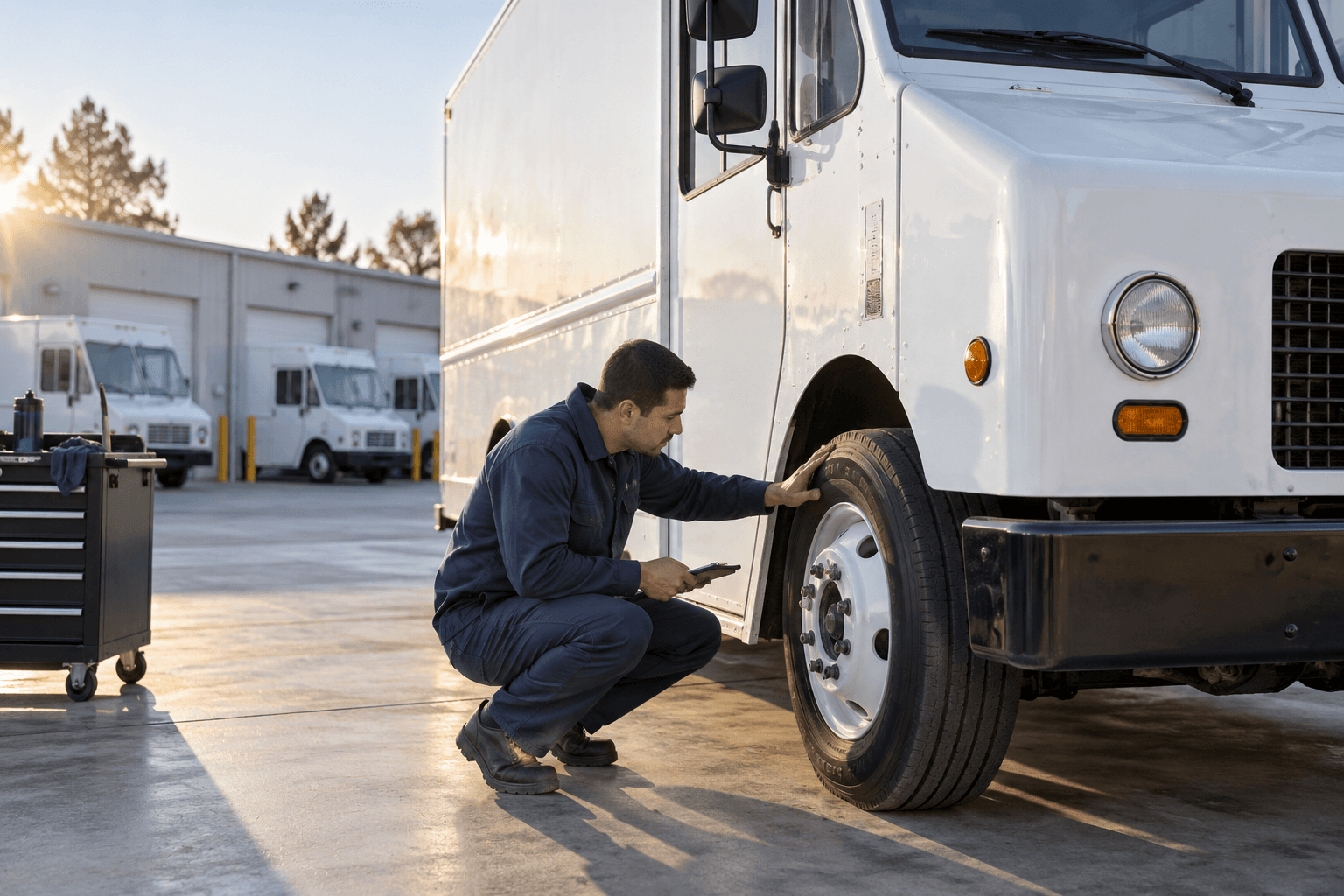
Know the truck's full operating width, including mirrors and other projections. Check that mirrors are correctly adjusted before the route, then use them to monitor the vehicle's sides as conditions change. Commercial driver guidance emphasizes managing lateral space because a wide vehicle has little spare room within a lane.1
The cab may appear to clear an obstacle while a mirror, body panel, rear corner, or open equipment compartment does not. Confirm that doors and equipment are secured before moving. When the clearance cannot be determined from the driving position, stop in a safe location and inspect it. Never ask someone to stand in a narrow pinch point beside a moving truck.
Treat parked cars as places people may emerge
Look for occupied seats, lights, movement inside the vehicle, and a person approaching from the sidewalk. An opening door or a pedestrian stepping between cars can change the path without much warning. Maintain enough speed control to stop if the space becomes occupied. A parked car is not merely a fixed obstacle to clear by inches.
Do not focus so intensely on the near mirror that you lose awareness of oncoming traffic or a crosswalk ahead. On a confined street, wait where there is adequate room for approaching vehicles to pass. A pause before the narrow section is easier to manage than a confrontation halfway through it.
Choose a different position when the gap is doubtful
Before pulling away from a curb, check the entire intended path and the nearby vehicles. Before reversing, inspect the area and follow the employer's backing procedure. Cameras can assist, but they do not eliminate blind areas or reveal every low object. If the situation changes, stop and reassess instead of continuing on the strength of the first check.
Avoid allowing delivery urgency to become a clearance estimate. A suitable space farther from the door may provide a safer approach and departure. If no legal, workable position is available, contact dispatch for an approved alternative. The customer expects the package to arrive without damage to the property around it.
Respond properly if contact occurs
Stop and assess the scene safely, even when the contact seems minor. Follow company reporting instructions and preserve relevant facts and video. In Pennsylvania, a driver who damages an unattended vehicle or property must stop, notify the owner or leave the required identifying and insurance information, and notify the nearest authorized police department without unnecessary delay.2 A note alone does not complete that requirement.
For Sigma Continental drivers working in Pittsburgh, knowing the response procedure before a collision prevents a bad situation from becoming worse. After the immediate response, review what made the clearance decision uncertain. A corrected parking approach, better route note, or earlier decision to wait is more useful than describing the event as just a scratch. Small contacts deserve serious learning because the next obstacle may be a person.
Sources and further reading
Review current guidance and follow the training and procedures provided for your role.
- Original Safety Articles collection
- Georgia Department of Driver Services — Commercial Driver Manual Section 2 Point 7 Point 4 Space Around Vehicles
- Pennsylvania General Assembly — Pennsylvania Vehicle Code Section 3745